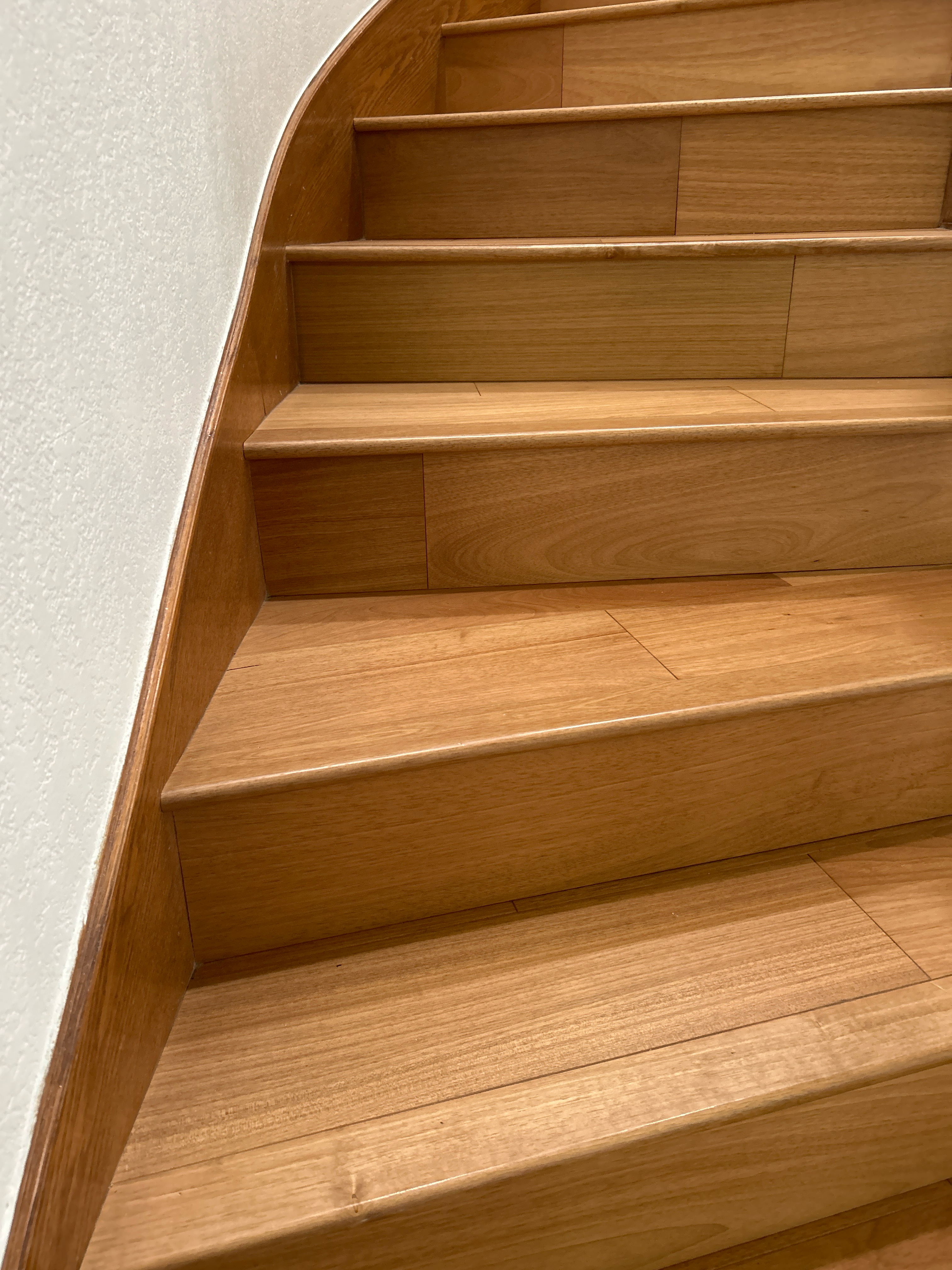
In summary, if you are looking for a craftsman-like, quality installation the first go-round, you might consider looking elsewhere for a contractor. At this point, I wouldn?t recommend Hubbard Flooring to install a floor in an outhouse. <br /> <br /> Now the details: <br /> The following summary is supported by photos that can be accessed on YouTube by entering the following search statement (without the quote marks) ?Hubbard Flooring Post Installation Photos". The photos are only a partial group of the photos and videos that were taken to document the Hubbard Flooring installation on August 12 & 13, 2013 at my home. <br /> <br /> The Hubbard crew was headed by Donnie Clem. After the installation, the homeowners spent over 20 hours cleaning the floor to try to remove marks and footprints left by the installation crew. This effort was an ?on hands and knees? project that we had not expected to have to perform. To this date, not all marks have been removed and another concentrated 10 hours of cleaning has taken place. <br /> <br /> To keep dust under control, as requested by the installation crew, the homeowner provided plastic sheeting and, as agreed, the installation crew taped the sheeting on the walls to reduce the spread of dust into rooms not involved in the flooring project. Unfortunately, the crew repeatedly let the sheeting fall and proceeded to work resulting in dust being driven into nearly every area of the residence. Had the crew paid attention to the sheeting, much of the dust could have been more locally controlled and the clean-up of dust in rooms not involved in the project would not have been necessary. <br /> <br /> At times the installation crew, using an aluminum A-frame ladder borrowed from the homeowner, marked walls when they leaned the ladder against the walls rather than opening it up as an A-frame ladder should be (and therefore never touch the walls). The homeowner had to touch up all such marks following installation. <br /> <br /> During the estimating and planning portion of the project, the homeowner was given the option of having the crew either remove existing baseboards or installing new baseboards (at an additional cost). The Hubbard Flooring rep, Donnie Clem, recommended removing the existing baseboards since it was easier and they had experience removing and re-installing baseboards without problems. Considering the damage done to the baseboards and the improper re-installation, it would have been better to have installed new baseboards. Installing new baseboards would have avoided the splitting that occurred during the removal and re-installation process. Installing new baseboards would have involved less effort than the significant amount of homeowner repair work required to repair the re-installed baseboards. <br /> <br /> When the T-Moldings were to be installed, the Hubbard crew had to use approximately 400 pounds of exercise equipment weights, borrowed from the homeowner, to hold the moldings down as the glue cured. They had no equipment to do this?.I have no idea what would have been done had I not had the weights. In the end, this was to no avail since the wrong glue and gluing method was used and the T-Moldings came right up, even after a couple of days of sitting with the weights in place. <br /> <br /> In addition to the terrible re-installation of the baseboards, the homeowner clean-up required, the marks on the floor, and the incorrect installation of the T-Moldings, over 30 areas on the floors were found to be hollow beneath the new flooring after the installation was completed. The floor had been leveled before any hardwood was laid but, nonetheless, over 30 areas were found where glue had not adhered to the floor and the hardwood. <br /> <br /> On August 17, 2013, a call was made to Jerry Hubbard to describe the problems and to request his personal review. <br /> <br /> On August 19, 2013, Jerry Hubbard visited the residence to review the issues. After initially making, or trying to make, excuses that voids in the flooring were normal and trying to adjust the baseboards might worsen the situation, he finally agreed to have the crew come back to make repairs and adjustments. That was the one and only time Mr. Hubbard visited the residence. From a customer?s viewpoint, the attempts to have me, the homeowner, accept the results of the initial installation were insulting. I have significant experience in remodeling projects and the explanations provided were inaccurate and condescending?meant only to convince me to let the deficiencies pass. Arrangements were finally made to have the crew return on August 26, 2013 to make repairs. <br /> <br /> When the installation crew returned on August 26, 2013 to remedy the multiple problems, they drilled approximately 30 holes into the flooring to ?flood? the area beneath the flooring with additional glue to fill the voids left during the first installation. As we pointed out the void areas, the reception we received made us feel that WE were ?at fault? for finding these hollow areas. Beyond the holes, two sections of flooring had to be completely cut out to replace the originally installed flooring due to no adhesion to the concrete floor and due to an installation error on Donnie Clem?s part. After being removed, the flooring sections were replaced-----then one of the areas had to be cut out again and replaced a second time the same day. <br /> <br /> Several sections of T-Molding had to be completely removed due to both the incorrect glue and the incorrect gluing technique which was originally used. With the exception of the T-Molding used where the dining room and entrance hallway meet, all T-Molding intersections were ?one piece? and straight. A total of 5 such intersections were involved. The dining room/entrance hallway T-Moldings also required compound miter corners since there was an elevation change between the wood flooring and the entranceway tile with the flooring being about 1/8-3/16? higher. It was apparent to me that the installation crew had cut the miter corners as if there was no elevation difference; therefore, when the moldings were installed where the elevation difference existed, the joints ?opened up? resulting in a gap in the joint that was very visible. It was later determined that the crew did not know how to make compound miter cuts. At the time of the initial installation, the crew observed that the fit was not correct but installed the moldings anyway. <br /> <br /> Having figured out the problem with the moldings? poor fitment and knowing that the moldings would have to be re-installed, prior to the crew?s arrival on 8/16 the homeowner constructed two compound miter ?jigs? for the installation crew?s radial saw so the installation crew could properly cut the joints making adjustment for the height differences. The homeowner had to instruct the crew on how to make such adjustments?.it was at this point that they acknowledged that they did not know how to make compound miter cuts. Following the homeowner?s instructions, proper joints were produced and no gaps in the joints occurred. <br /> <br /> All in all, the job was not done in a craftsman-like manner. The homeowner?s property was not respected and the techniques and contractor supplied materials were sub-standard. Poor workmanship on the contractor?s part caused the homeowner many hours to repair damages that were caused. I would certainly not recommend this contractor. <br />